Stories of Impact
By Alex Cook
Last Sunday, CSI led a tour of various industrial symbiosis projects in the growing town of McMinnville, Oregon.
The tour started with lunch at Honey Pie Pizza located in the Mac Market, an old shoe grease building renovated into a community gathering place. While they ate lunch, tour participants were given a presentation about industrial symbiosis by City Manager Adam Garvin, who explained how Industrial Symbiosis is the principle behind the use of 4,000 units of leftover sawdust per year to create construction items, and the use of a byproduct from hay farming for animal feed.
Then the tour stopped at New Energy Works, a timber framing company founded by Jonathan Orphin in New York. Outside of a concrete floor (from sustainable concrete, of course) and a few steel pins, New Energy Works's Oregon facility is made almost entirely of wood -- wood framing, walls and even wood-fiber insulation as a sustainable alternative to fiberglass.
Orphin explained that sawdust and woodchips are often shipped to China and Japan -- or disposed of. New Energy Works partners with Solid Carbon whose CEO, John Mead, explained that his company takes the woodchips left behind from wood framing to create organic “biochar,” which stores carbon in concrete which increases its strength by from 5 to 15 percent.
The final stop of the tour was the Chapul Innovation Center, a pilot facility for Black Soldier Fly farming. As explained by Founder and CEO Pat Crowley, over a third of food ends up in landfills. The Black Soldier Fly solution? Well, Black Soldier Flies! Feeding the food waste to fly larvae which are then harvested and fed to animals who in turn create nutrient-rich soil fertilizer.
The Chapul Innovation Center processes two tons of food waste per day, but their first farm, which will be fully operational in 2027, aims to process 50 tons per day. The heat generated by the flies is used to generate energy, which powers the machines used to process the food waste, creating a net-zero energy cost.
The McMinnville tour demonstrated local efforts to cut down on waste practically by reusing what we have to create new markets, stronger products, and bigger businesses. Industrial Symbiosis isn’t just healthy; it’s the smart choice for a business.
By Meredith Perdue
Experts, innovators, and researchers from Oregon, Washington and Denmark kicked-off the inaugural Industrial Symbiosis conference on June 28 at the Portland Food Innovation Center. Sheri Cole with Oregon State University’s Food Science and Technology Department highlighted the role Land Grant universities play in conducting the research into resource re-use -- the foundational principle of industrial symbiosis.
Three speakers explained how the keystone of industrial symbiosis is "circularity," which the Environmental Protection Agency defines as the practice of keeping resources and products in circulation for as long as possible.
OSU Professor Angee Hunt, demonstrated O.S.U.'s "100% Fish" program, which seeks to turn every part of a fish into a useable product, from omega-3s in skincare to fish skin bandages to protective wrap for the famous holiday pears from Harry & David.
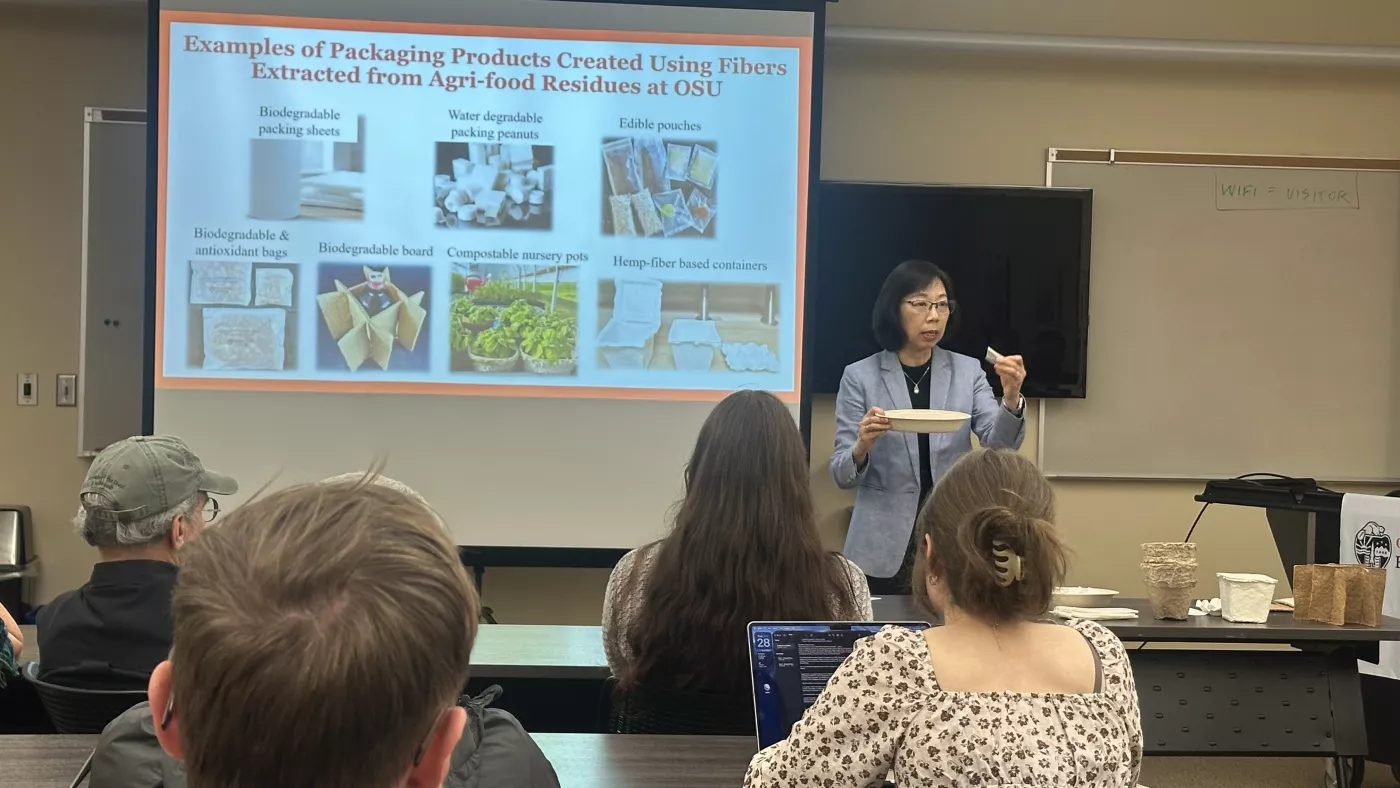
Similarly, the program's circular bioeconomy effort, presented by Yanyun Zhao, transforms agri-food biowaste into functional fibers and to create commercially viable alternatives to typical single-use, non-sustainable packaging such as packing peanuts and starch-based film to wrap baked goods.
Dairy side-streams like whey protein and bovine lactoferrin, explained Professor Younas Dadmohammadi, can be repurposed to target health issues such as anemia, a chronic health risk globally globe but a particularly acute one in sub-Saharan. According to Dadmohammadi, using milk as a “molecular toolbox” demonstrates how waste can become a product with new market value.
Rounding out the day was a moving discussion of the partnership between the Portland Metro Chamber and the Portland Clean Industry Hub, the aim of which is to create seamless relationships between business, government, and the environment.
“The way forward? Public and private, coming together, in radical transparency,” said Executive Vice President Public Affairs Jon Isaacs of the Portland Metro Chamber.
"After all, you can’t have carbon reduction without it being a business development tool. On the other hand, you can’t have business development without carbon reduction."
Subscribe
SDF email updates (about once a month)
Follow
Find us on social platforms


Scan Design Foundation
The Scan Design Foundation by Inger & Jens Bruun was established by the Bruuns to promote and strengthen the relationship between their native Denmark and their adopted home, the United States.
US Foundation
7724 35th Ave NE
Seattle, WA. 98115
Danish Foundation
Hedesvinget 22, 9520 Skørping
scandesignfonden.dk
Cookie Policy | Terms & Conditions
© Scan Design Foundation 2026. All Rights Reserved.
Who We Are
Vision & Mission
Staff & Board
Our Story
Contact
What We Support
Advancing Danish American Relations
Projects & Partners
Strategic Framework
Sharing Our Work
Our Grant Investments
Research & Reports
Information for Students
Updates


